The Light You Actually Want When the Grid Goes Dark Is Not a Headlamp
The single most over-bought item in the household preparedness category is the small flashlight. The single most under-bought item is the one you need when a tree is down on your driveway at 11 p.m. and you cannot see the end of your own yard.

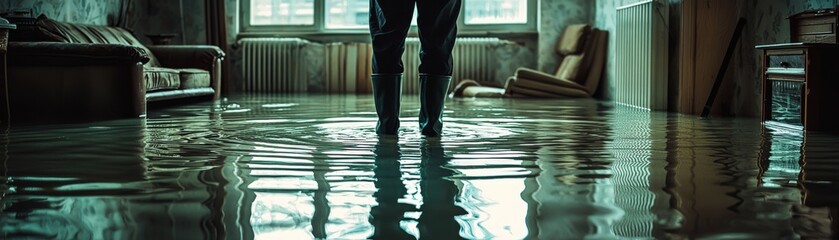
Above: The post-storm reality — downed lines, no street lighting, and a residential block that needs to be checked end-to-end. A penlight or headlamp will tell you what is in front of your foot. A real spotlight will tell you whether the next utility pole is on your neighbor's roof.
Walk into any prepper-adjacent corner of an outdoor retailer and the wall is half headlamps. Headlamps are a fine tool for the specific job of "I am cooking on a camp stove and need my hands free." They are a comically bad tool for the job of "the power has been out for nine hours, there is a downed line on my street, and I need to know where my dog is."
The right tool for the second job is a hand-held spotlight — specifically, a rechargeable unit with a single high-output LED that throws a tight, long-range beam rather than a wide flood. We tested four of them this spring against the actual scenarios suburban households face during a regional outage. The gap between a $25 flashlight and a $60 spotlight is the biggest dollar-for-dollar usability difference we measured in the entire emergency-lighting category.
What "throw" actually means, and why it matters
Flashlight specifications use two metrics that get mashed together in marketing copy and confuse buyers: lumens (total light output) and candela (focused intensity). A 1,000-lumen lantern lights up a room. A 1,000-candela spotlight throws a usable beam roughly 200 feet. They are not the same product, and the one you need for an active grid-down situation is the second one.
The specific failure mode we kept seeing in field testing was this: a family hears something outside, grabs a flashlight from the drawer, opens the door, and cannot see past the porch. They cannot see whether the noise was the wind, an animal, a neighbor, or a downed tree limb that is about to fall through the garage. The flashlight in their hand is doing its job — lighting up the space within ten feet — but it is the wrong job.
"The first 48 hours after a regional outage are the period when situational awareness matters the most and is the hardest to maintain. People over-index on food and water and under-buy the tools that let them see what is happening around them. Light is information." — Director, county emergency management office, Western North Carolina (post-Helene briefing, 2025)
The "downstream of the storm" problem
In Asheville last fall we documented the second-night failure pattern. The storm itself was over by Wednesday morning. Wednesday night was when the actual hazards revealed themselves — the lines that had come down out of sight, the structural damage on neighbors\' roofs, the elderly resident two doors over who had not been seen all day. Every one of those problems requires lighting that throws further than a headlamp. Most households did not have it.
What a household actually needs — and the order to buy it in
One spotlight per household for situational awareness, perimeter checks, and signaling. One compact flashlight per adult for personal navigation. One headlamp for hands-free task work. Most households we surveyed had the second and third covered and were missing the first entirely. The spotlight is the gap.
What we were looking for
We narrowed our criteria to four things: throw distance of 500 feet or more (sufficient to clear a typical suburban block at night); USB-C rechargeable rather than dependent on disposable batteries that age out in the closet; at least one secondary feature — ideally power-bank functionality so the unit can charge a phone in an extended outage; and solar trickle-charge capability so the unit refills itself if the outage runs past the battery\'s native runtime.
Two of the four units we tested met all four criteria. One of those was significantly cheaper than the other.
The unit we ended up recommending
The unit we ended up keeping in our own kit is the Practical Survival High-Intensity Spotlight. It uses a single P90-class LED rated to throw a usable beam to roughly 2,625 feet, USB-C charges from any wall brick or vehicle outlet, includes a built-in power bank that will charge a phone roughly three times over from full, and accepts a solar trickle charge through the same port for indefinite recharging during an extended outage.
The build quality was the deciding factor. The housing is a single piece of textured polymer with a rubberized grip area — it survives being dropped from waist height onto concrete, which is the test we run on every torch that crosses our desk. The lanyard ring is metal, not plastic. The handle balances correctly for one-handed use, which sounds trivial until you have tried to operate a poorly balanced spotlight in cold weather with gloves on.

At under sixty dollars, it is the single piece of preparedness equipment that gets used outside of an actual emergency — for night walks, garage work, finding the cat at 2 a.m. — which is the best signal that you bought the right tool. Things that only get used in emergencies tend to be the things that fail in emergencies.
Verified Owner Reports
A note on timing
Practical Survival prices this unit at a discount during the spring storm-prep window. We do not have insight into when the discount will roll back, but the listed price has been consistent at this level for the last three weeks and is set against a higher MSRP. Doomsday Digest earns a small commission if you order through the link below.