The Quiet Failure Mode Inside Your Bottled-Water Plan — And the 2-Pack That Fixes It
Your bottled water might keep you hydrated for 48 hours. It will not run a household. The reason every prepared family runs into the same problem on day two of an outage is the same reason restaurants don't serve soup out of Aquafinas: pouring water from a half-liter bottle into a stockpot is a contamination event waiting to happen. Here is the fix.

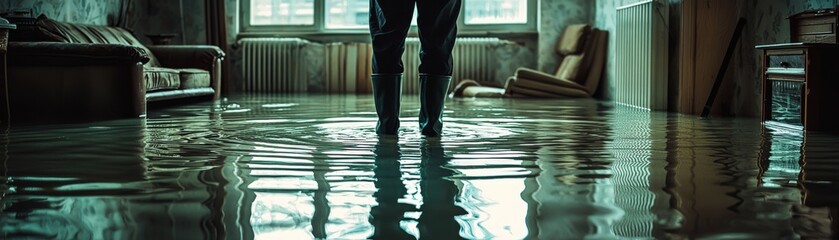
Above: The kitchen-counter reality of day two. Bottles half-emptied into a pot, water on the floor, no clean way to wash hands afterward. A boil-water advisory does not just demand clean water; it demands a way to handle that water that does not undo all the work.
Boil-water advisories happen, on average, somewhere in the United States every four to five days. Most are local and brief. About 15% of them last over 72 hours. The advisory itself is the easy part of the story — "do not drink the tap water." What no one tells you is how logistically annoying it is to actually live that instruction for a week.
The issue is not the water. The issue is the handling of the water. A normal kitchen workflow assumes you can turn on the tap and get clean output. When that assumption fails, you start pouring small bottles into bigger vessels — pots, pitchers, kettles — and every transfer is an opportunity to contaminate the next thing. The half-empty bottle that touched the counter is now an uncertain source. The pitcher that got rinsed in the (unsafe) tap before you remembered is now suspect. By day three, your kitchen looks like a chemistry lab and you have used twice as much water as you needed to.
What hospitals already figured out
The fix is so basic that nobody markets it well: a large-format water container with a built-in spigot. The same thing every hospital kitchen, every commercial caterer, and every elementary-school nurse's office in America has had since the 1970s. You fill it once, from your storage source. It pours cleanly on demand without anyone needing to touch the top of the vessel. The water inside stays uncontaminated until it is dispensed.
The reason it works is the same reason restaurants do not pour drinks out of jugs. A spigot is a one-way valve. Each pour does not require the lid to come off, the surface to be exposed, or anyone's hands to come into proximity with the storage water. In a normal week it is a convenience. During a boil-water advisory it is the difference between "we are getting through this" and "we are running out of safe water faster than we expected."
"The repeated mistake we see during multi-day water events is not contamination of the source — people understand they need to start with safe water. It is cross-contamination of the storage. Hands, surfaces, bottle tops, the dog. A spigot system eliminates roughly 80% of those transfer events." — County health department, post-Hurricane Idalia outreach materials, 2024
The second problem: storage geometry
Rigid water jugs solve the handling problem but introduce a new one: they take up the same volume empty as full. A household that wants to keep 10 to 15 gallons of contingency capacity in a closet is now committing four square feet of floor space to rigid plastic, year-round, for an event that may or may not happen. Most families look at that math and decide to keep skipping it.
The fix is a collapsible container — food-grade BPA-free plastic that folds completely flat when empty, takes up the space of a magazine, and inflates only when needed. The geometry change makes the entire category practical for households that do not have garage space to burn.
Why one is never enough
One container handles current use; the second one stores the next round so you do not run out while you are sanitizing the first. Every emergency manager we asked about this came back with the same answer: two minimum, ideally one filled at all times. The 2-pack configuration is not marketing — it is the operational pattern.
The unit we ended up recommending
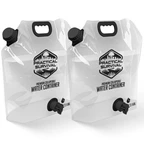
The container we ended up using ourselves is the Practical Survival Collapsible Water Container, 2.1 Gallon, 2-Pack. Each container holds 8 liters (2.1 US gallons), is made from BPA-free food-grade polymer, includes a reinforced spigot built into the side of the bag (not threaded into the cap, which is where the cheap units leak), and folds completely flat for storage. The pair costs less than a single Costco trip's worth of bottled water and replaces the problem entirely.
The spigot is the part that matters. The cheap collapsible containers use a screw-on plastic spigot that loosens, drips, and eventually fails. The Practical Survival unit uses a welded-in spigot with a quarter-turn lever — the same architecture you find on commercial beverage dispensers. We left one filled on a kitchen counter for ten days as a leak test. Zero seepage.

At under thirty dollars for the two-pack, this is the cheapest fix for the most under-discussed problem in household preparedness. Buy it, fill it, forget it. Refill twice a year for the cycle.
Verified Owner Reports
A note on timing
Practical Survival prices the two-pack configuration at a discount tied to the hurricane-season prep window. This pricing has been stable for the last month; we expect it to revert at the start of formal hurricane season. Doomsday Digest earns a small commission if you order through the link below.